String pool is a pool of string literals which is maintained by java.lang.String class. This pool contains distinct String literals with no two String literals having same value.
Thus a string literal having value “myfriend” can’t exist twice in String pool. There would be only one String literal in a String pool whose value can be “myfriend”.
The main purpose of the presence of String pool is to save memory and increase performance by preventing the creation of new String objects for those String literals in your code that are already present in the String pool. Thus String pool contains String literals (aka references to String objects) which get shared at many places in your code.
Note that any String literal in your code represents a reference to a String object having same value as the corresponding String literal has.
When we say String pool is pool of String literals it actually means it is a pool of references, not the pool of String objects themselves. String objects themselves are on the heap.
How String pool works?
What happens is that whenever a String literal is encountered in your program, then instead of creating a new String object for that literal, JVM first check whether there is any String literal with the same value already exists in String pool. If there is a string literal with the same value already present in the pool, then instead of creating new String object for that encountered String literal in your code, String literal from the pool is used. If there does not exists any string literal with the same value in the pool then a new String object is created, its reference is stored into the string pool and returned.
Consider this program:
public class PoolDemo{
public static void main(String[] args){
String firstString = "Hello";
String secondString = "Hello";
System.out.println(“Hello”);
}
}
In the above program there are three occurrences of string literal “Hello”. Each occurrence of “Hello” represents an object of String class.
Now suppose String pool does not have any string literal with value “Hello” in it.
Had there not been the string pool, then there would be three different objects of String class containing same value occupying their own memory, like:
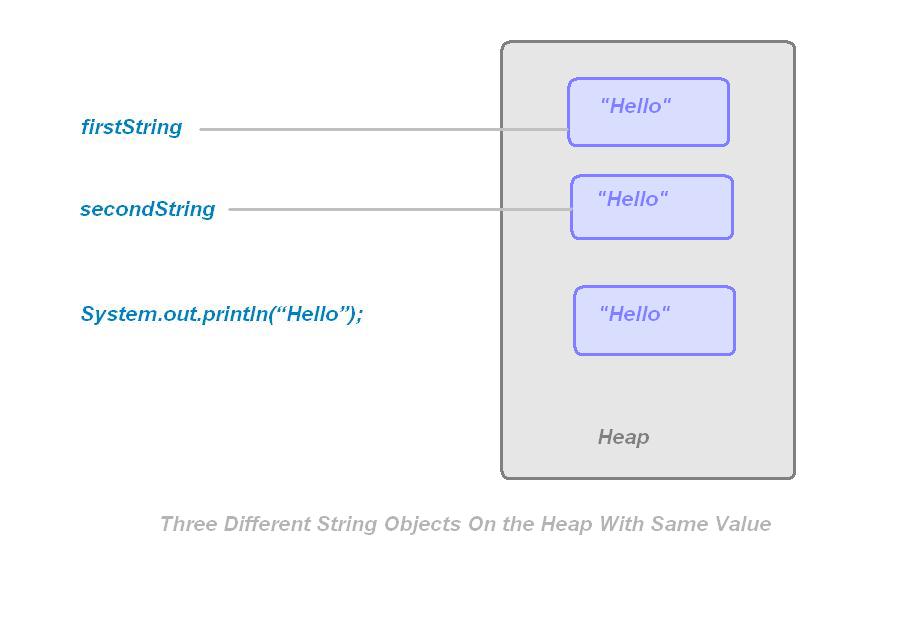
But with string pool all three occurrences of “Hello” will point to the same single String object, not the three distinct objects.
When first time “Hello” is referenced in String firstString = "Hello";, JVM will check whether there is already any String literal in the pool with value “Hello”. As we have assumed our string pool does not contain literal “Hello”, a new String object will be created with value “Hello” and its reference is stored into the pool. The reference to this newly created object is returned and assigned to firstString.
When you reference “Hello” second time in String secondString = "Hello"; then again JVM will check the string pool. As now there is already a string literal with same value (“Hello”) present there (just added before), so no new String object is created but the reference to already present object is shared and assigned to secondString .
Same thing happens when you reference the “Hello” third time in System.out.print(“Hello”);, no new object created but reference to “Hello” in String pool is shared.
Now all three occurrences of “Hello” points to single “Hello” object in String pool.

As instead of three different objects now there is only one String object with value “Hello”, it saves memory.
Whether firstString and secondString in above program points to same String object or not can be checked as:
public class PoolDemo{
public static void main(String[] args){
String firstString = "Hello";
String secondString = "Hello";
//Following line will print true
public static void main(String[] args){
String firstString = "Hello";
String secondString = "Hello";
//Following line will print true
System.out.println(firstString==secondString);
}
}
}
}
firstString == secondString giving result as true means that both firstString and secondString refer to same String object.
Not every String object goes to String pool…
String objects can be created in two ways:
1) String first=”Hello”;
2) String other=new String(“Hello”);
String objects created by “new”never goes to string pool. Therefore first is pointing to a String object whose reference is in the String pool while other is pointing to String object whose reference does not lie in the String pool.

We can check this by:
public class PoolDemo{
public static void main(String[] args){
String first = "Hello";
String other = new String("Hello");
//Following line will print false
System.out.println(first==other);
}
}
first==other comes out false this means that first and other do not point to the same object.
Though strings created “new” do not go to pool, you can store their references in pool by using intern() method of String class.
Interned String means String literal that resides in String pool.
String created as String s=”Hello”; are automatically interned.
While strings created by “new” needs to be explicitly interned if you want them to get stored in string pool
public class PoolDemo{
public static void main(String[] args){
String anObject = new String("abc");
String otherObject =anObject.intern();
//Following line will print false
System.out.println( anObject == otherObject);
}
}
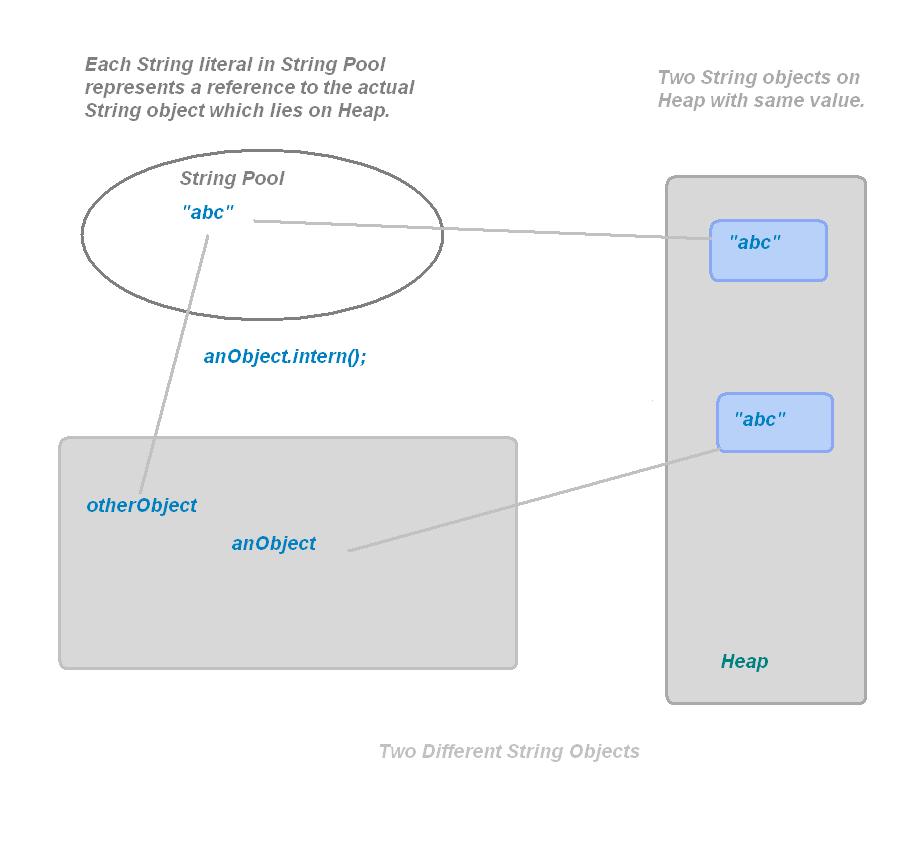
anObject does not represent a String object whose reference is in the String pool. While otherObject represents a String object whose reference is in String pool with same value “abc”.
Both are different objects as you can see from the result of anObject == otherObject which print false.
Now take this example.
For example:
public class PoolDemo{
public static void main(String[] args){
String first = "Hello";
String second = new String("Hello");
String third=second.intern();
//Following line will print true
System.out.println(first==third);
}
}
second does not represent a String object of pool while first represent a String object in pool. When we called second.intern() what happened is that JVM will try to create a new String object having value “Hello” to store in String pool. But there already presents a String literal there with the same value created by
String first = "Hello";. So instead of creating new String object it will return the reference of that object from String pool and store it in third. Thus both first and third now points to same object as shown below:

I would like to know your comments and if you liked the article then please share it on social networking buttons.
You may like:


